
Price Guide
All quotes include pricing for one color imprint and one location.


Grocery Retail › Custom Branded Bags
Trader Joe’s just released another reusable bag that’s selling out, getting traded online, and generating the kind of organic brand exposure most retailers spend millions trying to manufacture. The construction isn’t proprietary — and we make the same bag, ready to print with your brand instead of theirs.
Trader Joe’s new Stand-Up Collapsible Grocery Tote is the latest in a long line of TJ’s bag drops that have built one of the most unusual brand assets in grocery retail — a bag program that customers actively search for, trade, collect, and post about. Search volume for “trader joe’s reusable bags” and its variations totals roughly 4,800 monthly searches across nearly 200 related queries. That’s not normal for a grocery store’s bag program. Most grocery chains generate exactly zero branded bag searches.
If you run a grocery store, supermarket, co-op, or specialty food shop, the playbook behind that effect isn’t a secret — and the bag itself isn’t proprietary. This article breaks down what makes the TJ’s collapsible work, and shows you the exact same construction available with your brand on it.
The Bag Trader Joe’s Just Released
The new Trader Joe’s Stand-Up Collapsible Grocery Tote is exactly what the name describes: a structured, box-shaped tote with rigid sides, side carry handles, top carry straps, and a reinforced base that lets it stand upright on its own and hold its shape under a full load of groceries. It collapses flat for storage in a car trunk or pantry shelf. It holds up to six gallons. It’s printed in full color with the kind of vintage TJ’s illustration work — pastel skies, retro lettering, surreal botanical imagery — that customers have been collecting and re-selling on resale platforms for over a decade.
The construction matters. This isn’t a soft, slumping grocery tote. It’s a stand-up bag with structural integrity, designed for the actual mechanics of grocery shopping: load it without a second person holding it open, set it down without watching it tip, and stack it without crushing the contents underneath.
Why Trader Joe’s Bags Generate the Search Volume They Do
Trader Joe’s generates a category. Most grocery chains generate nothing. The reasons are worth understanding, because the same playbook is available to any grocer who wants to use it.
Distinctive Design Over Generic Branding
The TJ’s bag doesn’t put a corporate logo at the top center on a flat color background. It puts illustrated artwork across the entire bag — front, back, sides — that looks like a poster, not packaging.
Limited Drops Drive Collectibility
Trader Joe’s releases new bag designs in waves, sometimes regional, sometimes seasonal. Customers buy multiples. Designs sell out. A secondary market exists.
Full-Color CMYK on Every Panel
The bags use full CMYK process printing, which makes photographic-quality artwork possible across the entire surface. This is the technical specification behind the visual impact.
Structural Construction, Not Soft Tote
The new collapsible model adds the shelf appeal of a stand-up bag — it looks like a designed product, not a giveaway.
Three of those four levers are entirely about the bag itself: the print method, the construction, and the design choices made on the surface. Any grocery brand can pull those same levers. The fourth — the cult-of-TJ’s collectibility — is built over time through consistency. But it starts with releasing bags worth collecting.
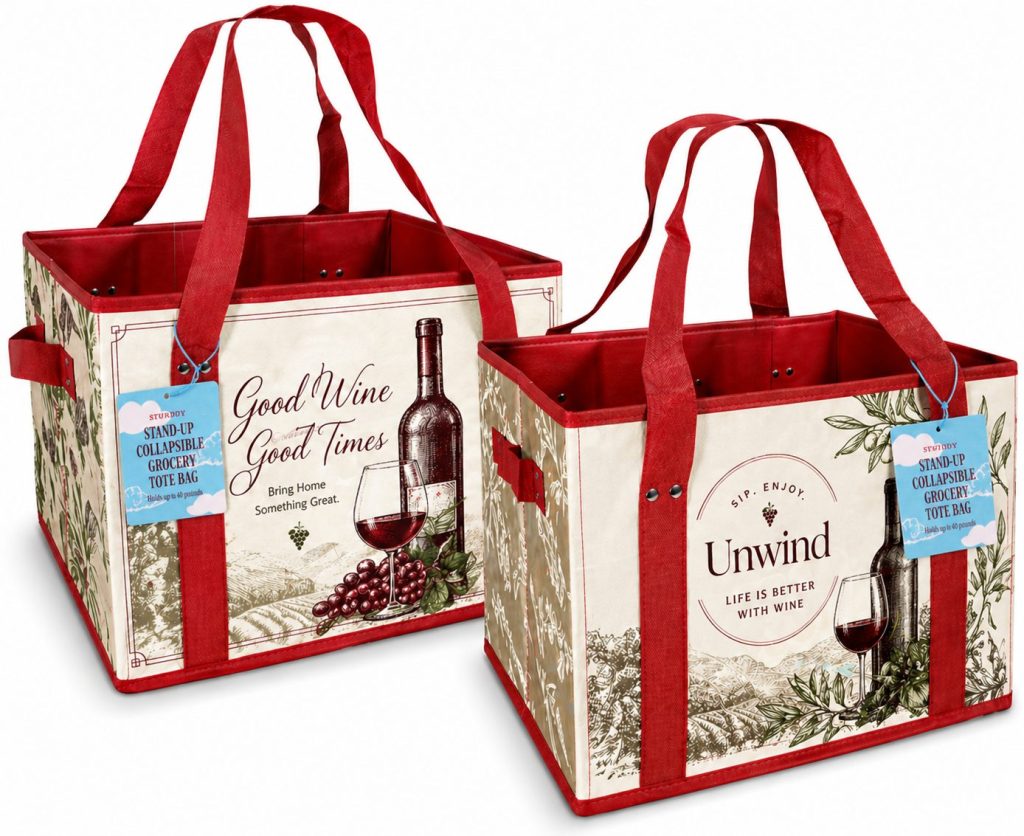
What Sets This Bag Apart
Stands Up On Its Own
Reinforced sides and base hold the bag upright while you load groceries — no second person needed to hold it open, no slumping over in the trunk on the drive home.
Full-Color Photographic Printing
Edge-to-edge CMYK printing on every panel — front, back, both sides. The same print method that makes the TJ’s bags collectible.
Holds Up to Six Gallons
A full grocery run, multiple wine bottles standing upright, oversized retail items — the cubic interior accommodates loads that flat-bottom totes can’t.
Folds Flat for Storage
The structural frame collapses flat for storage in a trunk, drawer, or shelf. Customers actually keep the bag accessible because it stows compactly.
Top Straps + Side Handles
Top straps for over-the-shoulder carry, side handles for two-handed lifting from the cart or trunk. Same dual-handle system the TJ’s bag uses.
Snap Closures at the Corners
Reinforced snap fasteners hold the box shape under load and release for fold-flat storage. The detail that turns a soft tote into a structural product.
What This Costs and Whether It Pays Back
Trader Joe’s runs roughly 600 stores. They order bags in production runs that put per-unit costs at the very bottom of the wholesale curve. You don’t need their volume to access the same construction — but the full-color CMYK printing that makes these bags work requires a 2,500-unit minimum order, with production timelines of roughly 60–90 days from approved proof to delivery.
For a single-store independent grocer or a small regional chain, a 2,500-unit order is a meaningful but modest investment. Bags then sell at the register for $2.99 to $5.99 — Trader Joe’s prices their collapsible at $2.99. The economics work even at modest sell-through, and every bag that leaves the store becomes a brand impression generator. Industry research puts the average reusable bag at roughly 5,938 impressions over its useful life — multiply that across 2,500 bags and you’re looking at nearly 15 million brand impressions per production run.
The Design Choices That Actually Matter
Having the right bag is half the equation. The other half is what you put on it. Here’s what separates a bag customers collect from a bag customers throw in a drawer.
Print across the entire bag, not just one panel. The default for promotional bags is a single front-panel logo. The TJ’s approach treats the bag as a canvas. Front, back, both gussets all carry coordinated artwork. This is the difference between a bag that reads as marketing and a bag that reads as product.
Use illustration, not photography of products. Trader Joe’s bags don’t show pictures of groceries. They show illustrated landscapes, vintage advertising aesthetics, regional motifs, characters, and scenes. This invites visual engagement in a way that product photography never does. A bag that looks like an art print gets carried with pride. A bag that looks like a flyer gets used until it’s worn out and thrown away.
Build a series, not a one-off. The reason TJ’s bags hold collectible value is that there’s always a new one coming. Customers know to buy the current design because next month it’ll be replaced. Even a small grocery store can run a quarterly seasonal release calendar — spring, summer, fall, holiday — and create the same anticipation effect at a much smaller scale.
Reference your geography, your brand voice, your community. Trader Joe’s regional bags (city-specific landmarks, state-specific imagery) outperform their generic ones consistently. Independent grocers have an enormous advantage here: you are local in a way TJ’s only mimics. A bag that pictures your downtown, your farmers market, your neighborhood, or your coastline is more powerful than anything a national chain can produce.
Frequently Asked Questions
Is this actually the same bag Trader Joe’s uses?
The construction is the same: stand-up structured box format, reinforced corners and base, dual handle system (side handles plus top carry straps), full-color CMYK photographic printing on every panel, and fold-flat collapsibility. The only difference is whose artwork goes on it. Trader Joe’s manufactures their bags through their own supplier relationships. We manufacture this format for any brand that wants it.
What’s the minimum order quantity?
2,500 units. The full-color CMYK process printing that gives these bags their collectible visual quality requires longer overseas production runs to be cost-effective, and 2,500 is the baseline minimum for that printing method.
How long does production take?
Approximately 60–90 days from approved proof to delivery. The CMYK printing, structural construction, and overseas manufacturing all factor into the timeline. We recommend planning a launch at least four months out to leave room for design revisions and proof approval.
Do you provide design help, or do we need our own artwork?
You provide the artwork; we provide the production. Most grocery brands work with a local illustrator, an in-house designer, or a freelance artist on the design itself, then send us the print-ready files. Every order includes a free digital proof for your approval before production begins, and our team will flag any technical issues with the artwork before it goes to print.
What sells better — selling these at the register or giving them away?
Both work, but they work differently. Selling at $2.99–$5.99 covers the bag cost and turns the program profitable while still putting branded bags in the market. Giving them away as a customer appreciation gesture — particularly tied to a loyalty program or a minimum purchase threshold — generates more goodwill but delays the financial return. Most grocery stores that have replicated the TJ’s effect sell the bags rather than give them away, because customers actually want to buy them when the design is good.
Can we order a smaller test run before committing to 2,500?
Not on this exact construction with full CMYK printing. If you want to test brand reception with custom bags before committing to the full minimum, our non-woven cube totes and standard grocery bags accept screen-printed artwork at 100–200 unit minimums. They won’t give you the photographic full-color visual impact of the collapsible bag, but they’re a way to test demand for branded bags in your store before the bigger commitment.
The Bottom Line
Trader Joe’s built a brand asset most retailers would pay millions for — a bag program customers actively search for, collect, and post about. The construction isn’t proprietary. The print method isn’t proprietary. The only proprietary part is their artwork — and your artwork is yours to make.
The Stand-Up Collapsible Grocery Tote is available with custom imprinting at wholesale pricing through ReuseThisBag.com, with free proof on every order and a 2,500-unit minimum on full-color production runs.
Related Articles
How to Choose Custom Grocery Bags for Your Store
Custom Grocery Bags for Meal Kit and Delivery Services
Ready to put your brand on the bag customers actually want to carry?
2,500-unit minimum for full-color production. Free proof on every order. Call us to talk through artwork, timeline, and what would work for your store.
or call 877-334-5323